.png)
Redefining Ownership in the Age of Climate and Geopolitical Tension

Updated: Jul 29

In a world where land ownership often means extraction and exploitation, a bold initiative is emerging from the High Arctic. This initiative is radically different. It’s about redefining ownership in the 21st century.
At the edge of the world, in the fragile archipelago of Svalbard, a global collective called Guardians of the Arctic is leading the charge. This is not ownership as domination, but ownership as custodianship.
At the heart of this initiative is Birgit Liodden, an environmental advocate and systems thinker. She is the founding custodian of what is described as the last privately owned land on Svalbard, a region of immense ecological, scientific, and geopolitical significance. Together with her partner organization, The Ocean Opportunity Lab (TOOL), they are working on ocean innovation, systems transformation, and collaborative solutions for planetary health.
Through this initiative, selected custodians from around the world—changemakers, scientists, founders, Indigenous voices, youth leaders, environmental organizations, explorers, philanthropists, and sustainability pioneers—are invited to become long-term co-custodians of Arctic land and its future.
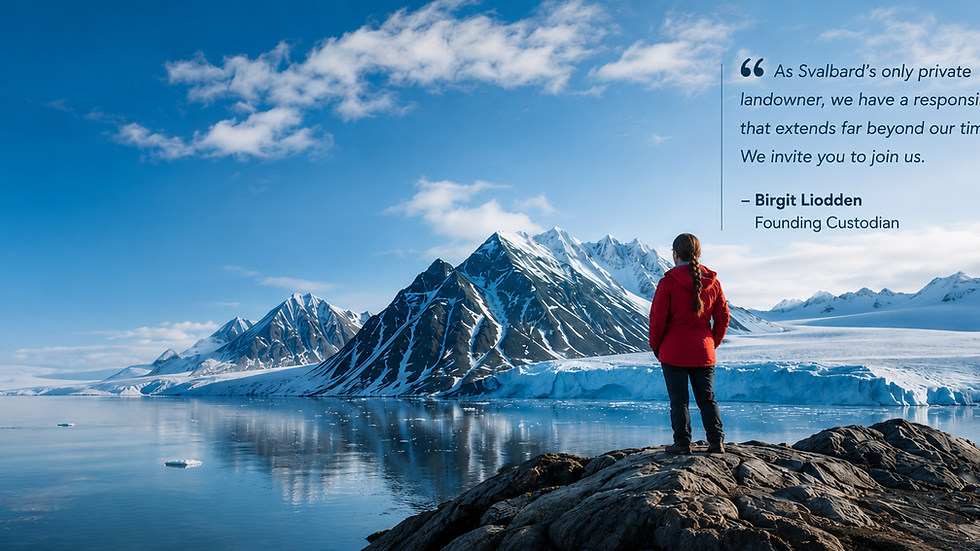
Among those invited into this growing global collective are individuals and organizations committed to protecting the ocean, biodiversity, climate stability, and future generations. Ocean Community is proud to support this vision, with our founder, Susanne Wedin-Schildt, being one of the early custodians.
A New Model of Stewardship
The initiative proposes a strikingly different philosophy of ownership. Instead of concentrating control, Guardians of the Arctic seeks to distribute responsibility. The vision is built around the concept of 7th Generation Custodianship, inspired by regenerative leadership principles such as:
Kaitiakitanga (Māori guardianship philosophy)
Ubuntu (African interconnectedness philosophy)
The 7th Generation principle, which asks us to consider the impact of decisions on generations yet unborn
This is not a luxury real estate project. It is a regenerative governance experiment designed to protect Arctic ecosystems while building a global coalition capable of acting across borders and sectors.
The shareholder pledge is unusually explicit:
Guardians commit to protecting the Arctic and its deep oceans, reducing geopolitical and intergenerational tension, supporting climate diplomacy, and helping finance ecosystem mapping, sustainable solutions, conservation initiatives, and even climate litigation.
In a time when many climate commitments remain symbolic, this initiative ties values directly to governance, land stewardship, and long-term accountability.
Why Svalbard Matters to the Entire World
To grasp the significance of this initiative, we must first understand Svalbard itself. Located midway between mainland Norway and the North Pole, Svalbard is one of the most environmentally sensitive and geopolitically important regions on Earth. It is also one of the fastest-warming places on the planet.
The Arctic is not a remote side story to climate change. It is a central regulator of Earth’s climate system. Although the Arctic Ocean covers only a small percentage of the world’s oceans, it plays an outsized role in carbon absorption, ocean circulation, temperature regulation, and biodiversity. Scientists increasingly describe the Arctic as a planetary stabilizer. But the region is under accelerating pressure.
The Arctic Is Becoming a Geopolitical Battlefield
As sea ice melts and warming accelerates, the Arctic is opening up—physically, economically, and militarily. This transformation is reshaping global geopolitics.
The Arctic now sits at the intersection of:
Climate breakdown
Resource competition
Military strategy
Shipping routes
Rare minerals
Energy security
National sovereignty
Scientific research
Deep-sea ecosystems
Major powers, including the United States, Russia, and China, are showing growing interest in the Arctic. New shipping routes could significantly shorten trade distances between Europe and Asia. Vast reserves of oil, gas, rare earth minerals, and critical resources are becoming increasingly accessible as ice retreats. This has triggered intensified competition.
At the same time, militarization in the Arctic has increased sharply in recent years. The fragile region risks becoming another arena for global confrontation. Guardians of the Arctic openly addresses these realities rather than ignoring them. The initiative recognizes that environmental collapse and geopolitical instability are deeply interconnected.
Protecting Arctic ecosystems is no longer just an environmental issue. It is also a matter of peace, diplomacy, security, and long-term planetary stability.
The Svalbard Treaty: A Forgotten but Visionary Agreement
One of the most fascinating aspects of this initiative is its connection to the historic Svalbard Treaty. Signed in 1920, the treaty granted Norway sovereignty over Svalbard while also establishing important international rights and obligations. Remarkably for its time, the treaty included language related to environmental protection and peaceful use of the region. It also prevented Svalbard from becoming a militarized war zone.
More than a century later, those principles feel increasingly relevant. The initiative positions itself not against nations but as a complementary civil society effort. It is a global coalition attempting to strengthen stewardship, diplomacy, scientific collaboration, and ecosystem protection in a time of rising fragmentation.
Protecting Ecosystems Beyond Borders
The Arctic’s ecosystems do not recognize political boundaries. Ocean currents, biodiversity systems, atmospheric circulation, fish migration, and climate feedback loops operate across nations and continents. Melting glaciers and permafrost release greenhouse gases, and changes in Arctic ocean circulation affect weather patterns globally. Loss of biodiversity impacts entire marine food systems. What happens in the Arctic affects all of humanity.
Commercial fishing, shipping, tourism, deep-sea mining interests, and fossil fuel exploration continue to expand northward. The initiative frames Arctic protection not as a regional concern but as a global responsibility.
Its stated mission includes:
Ocean ecosystem mapping
Biodiversity protection
Climate diplomacy
Supporting sustainable solutions
Collaborative stewardship
Intergenerational responsibility
Regenerative financing models
A Different Type of Leadership
One of the most compelling aspects of Guardians of the Arctic is that it merges science, governance, philanthropy, environmental protection, systems thinking, and cultural values into one shared framework. This reflects a growing realization: The crises we face cannot be solved within isolated silos.
Climate change, biodiversity collapse, ocean degradation, geopolitical instability, economic systems, and social fragmentation are interconnected. Addressing them requires new models of collaboration.
As Birgit Liodden expresses in the founding vision of the initiative, "This is ultimately about inviting a new generation of custodians, explorers, and leaders to step forward, not only to protect a place but to help redesign the relationship between humanity, nature, governance, and future generations."
The initiative asks an important question: What if ownership was measured not by extraction rights but by responsibility to future generations?
Ocean Community’s Role
We are proud to announce that our founder, Susanne Wedin-Schildt, is part of the group of Honorary Custodians and Expert Advisors.
As an international platform dedicated to ocean awareness and literacy, innovation, collaboration, and regenerative blue economy transformation, Ocean Community is proud to support and partner with initiatives that seek to protect our shared planetary systems.
The Arctic and the ocean are deeply interconnected. The future of ocean health, climate stability, biodiversity, and peaceful international collaboration will depend on whether humanity can move from fragmented short-term thinking toward collective stewardship.
Initiatives such as Guardians of the Arctic may not hold all the answers. But they represent something increasingly rare and urgently needed: the courage to experiment with new models before existing systems fail beyond repair.
A Call for the Next Generation of Custodians
At its core, Guardians of the Arctic is not only about land in Svalbard. It is about redefining humanity’s relationship with the Earth. We must recognize that the future cannot be secured through competition alone. Some places on Earth are too important to be treated merely as assets. The Arctic is one of them.
Future generations may ultimately judge us not by what we owned, but by what we chose to protect.


Comments