.png)
OCEANIC DATA SHARING AND THE LAW OF THE SEA

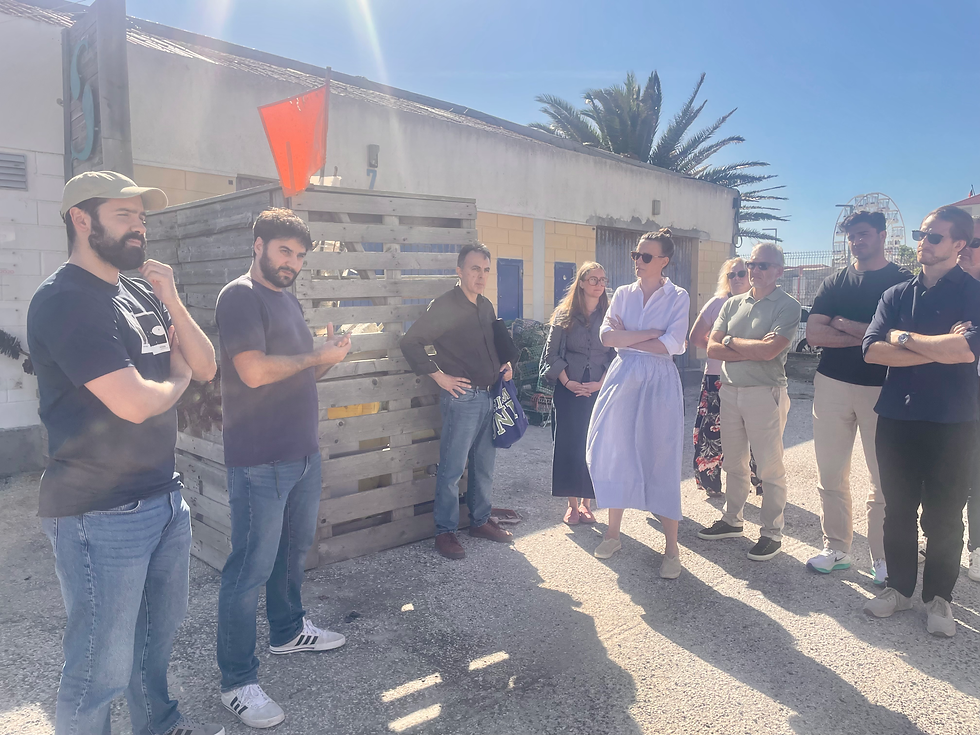
On September 16th 2026, Ocean Community participated in a seminar focusing on Data sharing and the Law of the Sea. The Seminar was organised by IHO, IAG , Advisory Board on the Law of the Sea (ABLOS) in collaboration with IOC-UNESCO and the Portuguese Hydrographic Institute.

As Open as Possible and as Closed as Needed: What Ocean Data Can Tell Us About Ocean Governance
How much do we really know about our ocean? We have mapped more of the surface of Mars than we have mapped the ocean floor, while the ocean itself remains one of the most important systems supporting life on Earth.
At the ABLOS Seminar on Oceanic Data Sharing and the Law of the Sea, hosted by the Portuguese Hydrographic Institute, experts from science, hydrography, law and ocean governance came together to discuss a question that is becoming increasingly important:
How can we share the knowledge we have about the ocean while navigating the legal, political and practical boundaries that come with it?
One idea followed the discussions throughout the day:
“As open as possible and as closed as needed.”

This statement captures a central tension in ocean data governance. Open and accessible data can improve scientific research, forecasting, safety and decision-making. At the same time, some information can be sensitive, costly to collect or subject to legitimate
restrictions.
Finding the balance between these interests is becoming increasingly important as our use and understanding of the ocean grows.
Key perspectives from the day
The seminar brought together a wide range of perspectives on how knowledge about the ocean is created, shared and governed.

Luis Menezes Pinheiro, National Committee for the Ocean Decade, opened with the importance of ocean observations being archived and shared so they can support research, forecasting and safety.
Aldino Campos, UN Commission on the Limits of the Continental Shelf, highlighted the enormous gaps that still exist in our knowledge of the ocean floor.
Vasco Becker-Weinberg, EMEPC, spoke about Portugal's experience with marine spatial planning, EMODnet and the importance of scientific cooperation between states.
Tiago Pitta e Cunha, Oceano Azul Foundation, challenged us to look beyond national boundaries and see the ocean as one interconnected planetary system and a fundamental life-support system.
Joana Beja, EMODnet, introduced EMODnet and explained how its different thematic areas bring together ocean data from different sources, helping to make information about the marine environment more accessible and usable.
Fernando Carrilho, IPMA, presented the potential of smart submarine cables for monitoring seismic activity and the seafloor.
Duarte Lynce de Faria, Portuguese Naval School / CINAV, focused on the protection of submarine cables and the role of legal frameworks in safeguarding this critical infrastructure.
Fátima Castro Moreira, University of Porto, RADM Najhan Md Said, National Hydrographic Center Malaysia, Júlia Schutz Veiga, NOVA School of Law, and Niccolò Bassan, IOC-UNESCO, brought different perspectives on BBNJ, marine spatial planning, capacity-building and marine geospatial information.
CFR Telmo Geraldes Dias, Portuguese Hydrographic Office, emphasised that accessibility increasingly also means making data usable by machines.
The final panel, moderated by Laura Meyer, IOC-UNESCO, brought together Virginie Tassin Campanella, ABLOS; Ana Hilário, University of Aveiro; and Jean Aude, Ocean Decade Corporate Data Group, to discuss data gaps and the role of the private sector in ocean data sharing.

Together, these perspectives raised a bigger question: what happens to ocean data once it has been collected?
From data collection to shared knowledge
Collecting ocean data is only the first step. Observations need to be archived, standardised, made accessible and connected to the people and systems that can use them.
The discussions around IODE and EMODnet showed how important this infrastructure is. Ocean observations become much more valuable when they can be brought together and used for research, forecasting, marine management and safety.
At the same time, missing data has very clear consequences. Gaps can mean repeated measurements, additional costs and delays, while limited access to existing information can contribute to weaker decisions.
This shifts the focus from simply asking how much data we have to asking how effectively we can share and use what already exists.
But openness also has limits. The recurring principle of “as open as possible and as closed as needed” captures this tension well. Not every dataset can or should be fully public.
Questions of security, cost, ownership and legal responsibility all shape to which extent information can be shared.
One ocean, many jurisdictions
The ocean is interconnected, but its governance is not. Ecosystems, currents, pollution and climate processes do not stop at national borders, while international law is still largely organised around jurisdictions, responsibilities and areas of competence.
The discussions around the BBNJ Agreement highlighted some of these challenges. Effective implementation requires not only legal frameworks, but also scientific knowledge, marine geospatial information, technical capacity, cooperation and access to technology.
The same applies to marine spatial planning. Making decisions about how marine space is used requires different types of data and the involvement of different actors. Looking at the ocean only as separate national spaces or as a collection of resources risks overlooking the interconnected system they form.
Who is missing from the data?
One of the clearest themes of the final discussions was the role of the private sector. Companies can hold valuable marine data, yet much of this information does not necessarily make its way into shared systems.

There are many reasons for this: sharing data can require time, technical knowledge and financial resources, while questions around confidentiality, ownership and future use can also make organisations hesitant to contribute.
Simply asking industry to “share more” is therefore not enough. What is needed is genuine cooperation between science and the private sector, including mechanisms that recognise the effort involved in producing, preparing and sharing data.
This also means thinking about accessibility beyond human users. Data needs to be available in ways that allow different systems and machines to find, process and use it. If data cannot be effectively accessed or understood by the systems working with it, its potential remains limited.
Where do we go next as Ocean Community?
Better ocean governance is not only about producing more knowledge. It is also about connecting the people who produce, hold and use that knowledge.
We left the seminar with new connections and a clear sense that more perspectives need to be brought into the conversation, particularly from industry. Researchers, policymakers, civil society and businesses all have different forms of knowledge and different roles to play.
The ocean may be governed through different jurisdictions, sectors and institutions, but the challenges we face are shared.
The task ahead is to make ocean knowledge as open as possible, as closed as needed, and connected enough to help us make better decisions and develop better solutions for the one ocean we all depend on.


Comments