.png)
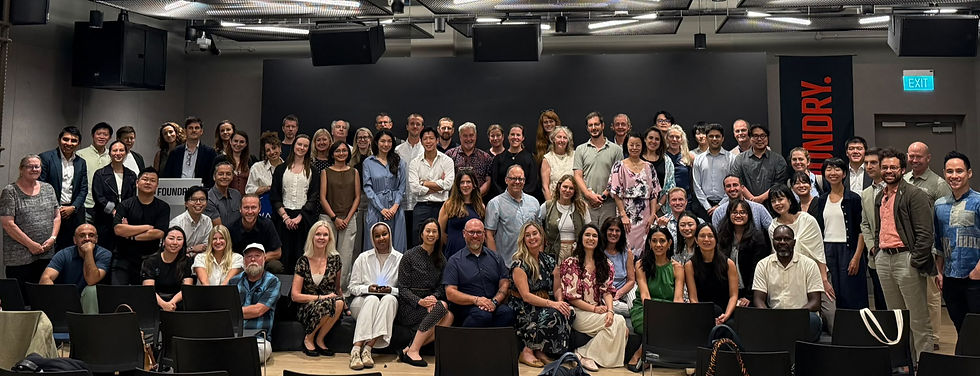
Ocean Community at the 1000 Ocean Startups Annual Gathering in Singapore

In September, Ocean Community joined the 1000 Ocean Startups Annual Gathering in Singapore, bringing together members of the global ocean innovation community for several days of exchange around one central issue: how to accelerate the transition from promising ocean innovation to implementation and scale.

The gathering came at an important moment. The ocean innovation ecosystem has developed rapidly in recent years, with a growing number of ventures, investors, accelerators, corporates and public actors entering the field. That growth is encouraging, but it also makes the next phase more demanding. It is no longer enough to identify strong technologies and support individual founders. We increasingly need to strengthen the systems around them so that viable solutions can reach customers, access appropriate capital, enter new markets and move from demonstration to commercial deployment.
Singapore provided a particularly relevant setting for this discussion. Asia is central to the global maritime economy and is home to many of the industries, coastal communities and marine ecosystems where the need for new solutions is especially acute. The region combines major opportunities in shipping, aquaculture, food systems, energy, coastal resilience and marine technology with significant environmental and climate pressures. Seeing the ecosystem from this perspective reinforced the importance of understanding how innovation moves across very different regulatory, commercial and geographic contexts, and how global networks can help connect solutions with the markets where they can create the greatest value.
For Ocean Community, one of the most important reflections from the gathering was the need to combine global reach with stronger regional activation. International networks are valuable because they connect knowledge, experience, capital and opportunity across borders, but implementation ultimately takes place within specific ecosystems. Companies need customers, partners, investors, research institutions and public authorities that understand local conditions and can help move solutions forward. This is one reason why our own model is evolving through a global hub and gateway in Portugal, complemented by deeper regional engagement through Ocean Community Nordic. The intention is not to create separate structures, but to build stronger bridges between regional capability and international opportunity.

Capital was a recurring theme. Ocean innovation is often discussed in terms of a financing gap, but the challenge is more complex than the simple absence of capital.
Different forms of finance exist, from grants to venture capital, corporate investment, project finance and infrastructure capital, what is missing is continuity between them. A company may be able to fund research but struggle to finance commercial deployment, or attract venture investment without yet having access to the capital required for larger infrastructure. Alignment between these funding stages is becoming increasingly important.
This thinking will inform the development of Ocean Community’s Blue Capital Orchestration initiative, which will work across our innovation arenas to strengthen the connection between viable solutions and the forms of capital they need to progress. The aim is to activate more private capital while also improving coordination between existing financial instruments, investors, corporates and public funding mechanisms. For us, this is part of a broader effort to strengthen the pathways from innovation to implementation rather than treating finance as a separate conversation.

The Singapore gathering also underlined the value of regional perspectives within a growing global coalition. As the 1000 Ocean Startups community expands, there is an opportunity to deepen collaboration within regions while preserving the benefits of a global network. Europe, Asia and other parts of the world each have different industrial strengths, policy environments, investment landscapes and implementation needs. Stronger regional structures can therefore make global collaboration more effective by creating clearer entry points for joint projects, market access, investment and knowledge exchange.
Ocean Community remains strongly committed to the 1000 Ocean Startups community and to the role it can play in connecting the organisations that are already supporting the next generation of ocean solutions. The opportunity ahead is to translate that growing network into even stronger collective capability, with greater emphasis on deployment, regional activation, capital coordination and practical pathways to scale.
The gathering in Singapore reinforced our conviction that the ocean innovation movement is entering a new phase.
What gives this coalition its strength is not simply its size, but the fact that organisations across countries, sectors and markets have chosen to work together around a shared purpose. Collectively, the 1000 Ocean Startups community has already helped identify, support and accelerate a significant share of the solutions needed to advance SDG 14, demonstrating what becomes possible when expertise, capital, networks and opportunity are connected across borders. That is worth celebrating. It is also a powerful reminder that the next generation of ocean solutions will not be built by any one country, fund, company or organisation alone, but through a global community capable of finding what works, helping it move faster and ensuring that the strongest solutions can travel far beyond the ecosystems in which they began.


Comments